University of Nebraska-Lincoln
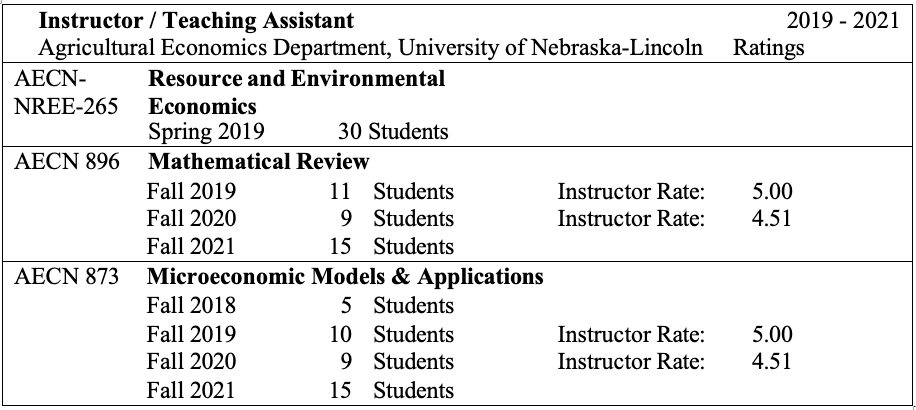
AECN- NREE-265- Resource and Environmental Economics
Introduction to environmental and natural resource economics and the role of such concepts in natural resource management. Application of economic principles to actual natural resource/environmental issues with focus on tradeoffs, cost and benefits, and decision making.
AECN 896 – Special Topics: Mathematical Review
Introduces fundamental mathematical tools and concepts essential for graduate-level study in Agricultural Economics, with a focus on their application to microeconomic models and analysis.AECN 873 – Microeconomic Model and Applications
AECN 873– Microeconomic Model and Applications
Analysis of microeconomic decision-making by individuals and firms, with emphasis on consumer demand, production, cost and profit functions, market structures, and the economics of game theory, uncertainty, and information.
Select Student Evaluation Quotes
“Diya is a great instructor. She communicates the material clearly and effectively. She is receptive to students’ questions and provides thoughtful answers to clarify confusion. Also, her handwriting on the whiteboard is impeccable.”
“Diya showed the understanding of the material. And she is very good at teaching and understanding students. Overall, Diya did a great job. I learned a lot from the session.”
“Diya is very patient, ready to help whenever on whatever, ready to explain material, and a pro from the beginning.”
“Diya helped me understand how to apply what we learned in class to real problems.”
University of Delaware
APEC-820- Experimental Economics
This graduate-level course introduces the design and implementation of laboratory experiments, field experiments, and randomized controlled trials in economic research. Students engage with foundational experimental games and key literature that shape the field of experimental economics. Through a combination of lectures and active participation in experiments, students gain practical and theoretical understanding of experimental methods. Each student will develop and execute an original experiment or replicate a published study, culminating in a written research project.

 Diya Ganguly